Shopi5ProRequest a Quote

ANONYMISED CASE STUDY · TECHNICAL SEO

A Shopify Migration With Technical SEO Built In.

A site migration introduces technical risks: changed URLs, missing metadata, broken links and search engines discovering a new structure. This project focused on preserving the important technical foundations and verifying the live site after launch.

Anonymised client project · Technical SEO & Migration

Illustrative launch-day checks panel listing the areas checked on the live site: analytics tags, legacy redirects, robots.txt, sitemap, titles and canonicals, headings and alt text, structured data, and the priority recrawl.

Illustrative example · layout, not a client screenshot

Project Overview

A relaunch changes many things at once. The work here was to carry the store's search foundations across intact, check them on the live site on launch day, and keep watching how Google rediscovered the new structure afterwards.

Anonymised client project: Confidential e-commerce project. Selected projects are anonymised to respect client confidentiality.

Client
Confidential e-commerce project
Platform
Shopify, relaunched on a new theme
Focus
URLs, metadata, structured data and indexing
Timing
Before launch, launch day and the weeks after
Evidence
Milestone delivery report

What we found

The Challenge

The migration required careful handling of legacy URLs, metadata, structured data, internal links and indexing. The previous setup also contained missing descriptions, images without alt text and redirects leading to unavailable pages. Left unaddressed, each of those is a way for a store to lose the search visibility it has built up.

  • Redirects that led nowhere

    Several existing redirects already pointed at pages that had been removed, so visitors and crawlers following old links reached dead ends.

  • Gaps in page metadata

    Products, collections, pages and articles had no meta description, and images across the site had no alt text.

  • Templates that dropped things

    The new theme's templates left some pages without a main heading, and text that had lived inside an old template did not come across on its own.

  • Structured data tied to an app

    Product ratings markup on the old site came from an app script that the new theme did not include, so it would have disappeared at launch.

Before changing anything

The Technical Investigation

Before launch we built an inventory of the legacy URLs that mattered and mapped each to its destination on the new site. After launch we tested those destinations, crawled the new site, and compared titles, canonicals, headings, image alt text and structured data against the previous templates. Search Console was used to confirm how Google was discovering the new structure.

  • Legacy URL inventory and redirect map.
  • Post-launch crawl of the new site for broken links, missing metadata and heading problems.
  • Template-level comparison of titles, canonicals, headings, alt text and structured data.
  • Search Console review of crawl activity on priority pages.

Illustrative redirect-mapping table with fictional store URLs: each legacy address, its destination, the number of redirect hops and a result such as live in one hop, repointed from a removed page, or no live replacement.

Illustrative example · fictional URLs

How We Approached It

The checks were split across three moments, because each one catches problems the others cannot.

  1. Before launch

    Protect what exists

    • Inventory of the legacy URLs that matter
    • Redirect map from each old address to its new destination
    • Template comparison of titles, canonicals, headings, alt text and structured data
    • Product page text compared line by line with the old site
  2. Launch day

    Check the live site

    • Analytics tags firing once, on each page type
    • Every legacy URL crawled and its destination tested
    • Robots.txt reviewed, sitemap resubmitted
    • Titles, canonicals, headings, alt text and structured data checked live
  3. After launch

    Watch and correct

    • Priority pages submitted for recrawling
    • Search Console compared with the weeks before launch
    • Content that did not survive the move restored
    • Weekly summaries of what changed and what was fixed

The work completed

What Was Implemented

Redirect map, then redirect tests

Every legacy URL that mattered was mapped to its destination before launch, then crawled on the live site. Redirects that pointed at removed pages were repointed, so old addresses reach a live page in one hop at most. The exceptions were old addresses with no live replacement and almost no search visibility, recorded rather than forced onto an unrelated page.

Templates compared field by field

Titles, canonicals, headings, image alt text and structured data on the new templates were compared with the old ones. Titles and canonicals were carried across unchanged; missing headings were added without changing how the pages look.

Comparison of old and new templates by field: titles and canonicals carried across, missing headings, descriptions and alt text added, ratings markup moved from an app script into the theme.

Structured data rebuilt in the theme

Organisation, article and FAQ data were set out consistently, and product ratings markup was moved into the theme itself so it no longer depended on an app script. Ratings in the data match the stars shown on each product page.

Simplified product template snippet that outputs product structured data from the theme, including the rating only when the product has one, using the same data as the visible stars.

Delivered, item by item

  • Reviewed the legacy URLs and tested their destinations after launch.
  • Verified that the legacy URLs reached live pages within at most one redirect hop. The few exceptions were low-visibility legacy addresses without live replacements.
  • Confirmed that every sitemap URL returned a live page.
  • Wrote the missing meta descriptions and added alt text to the images that lacked it.
  • Repaired broken internal links and repointed links to a discontinued product.
  • Corrected missing main headings and verified a single H1 on checked pages.
  • Checked structured data and confirmed no errors on the pages reviewed.
  • Confirmed that the priority pages had been recrawled by Google.

Evidence

Verification and Documented Outcomes

The launch review checked analytics tags, redirects, robots.txt, sitemap URLs, titles, canonicals, headings, image alt text and structured data. Google Analytics tracking was verified on representative page types.

How the Work Was Checked

  • Analytics and marketing tags were confirmed firing once each on a product page, an article and the homepage, with no duplicate tags.
  • Every legacy URL was crawled on the live site after launch and its destination recorded.
  • Robots.txt was reviewed and the sitemap resubmitted to Google on launch day.
  • Titles, canonicals, headings, alt text and structured data were checked on the live pages, not only in the theme editor.
  • Priority pages were submitted for recrawling, and Search Console was used to confirm when Google had recrawled them.
  • Anything found after launch, such as content that had not survived the move, was fixed and added to the record.
Verification record
AreaStatusNote
RedirectsVerifiedLegacy URLs reach live pages within one hop; the exceptions were legacy addresses with no live replacement.
SitemapVerifiedEvery sitemap URL returns a live page.
Structured dataVerifiedNo errors on the pages reviewed.
AnalyticsVerifiedGoogle Analytics tracking confirmed on representative page types.
Priority recrawlVerifiedThe priority pages had been recrawled by Google at the time of the report. Recrawled is not the same as indexed, and no indexing claim is made.
Page speedOut of scopePerformance was not part of this work and no speed improvement is claimed.

What the Evidence Shows

The documented checks confirm a functioning redirect map, a live sitemap, resolved on-page omissions and recrawling of the priority pages. They do not establish that rankings or organic traffic increased after launch.

What the Project Delivered

  • Old addresses that still work

    A tested redirect map, so links and bookmarks to the old site reach live pages.

  • Foundations carried across

    Titles, canonicals, descriptions, headings, alt text and structured data in place on the new site.

  • A written account of launch

    A delivery report of every check, every fix and what to watch in Search Console next.

What you receive

The Report You Receive

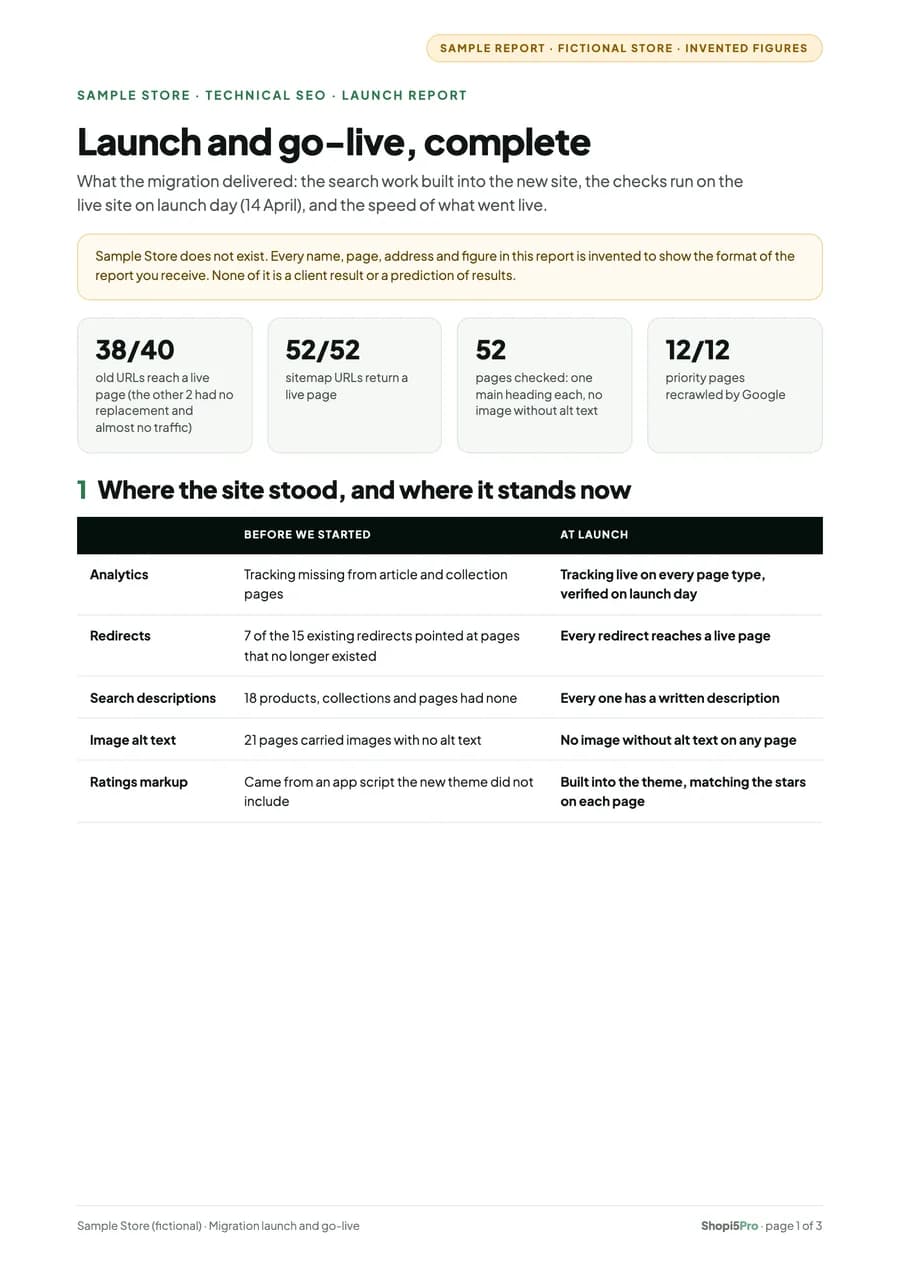
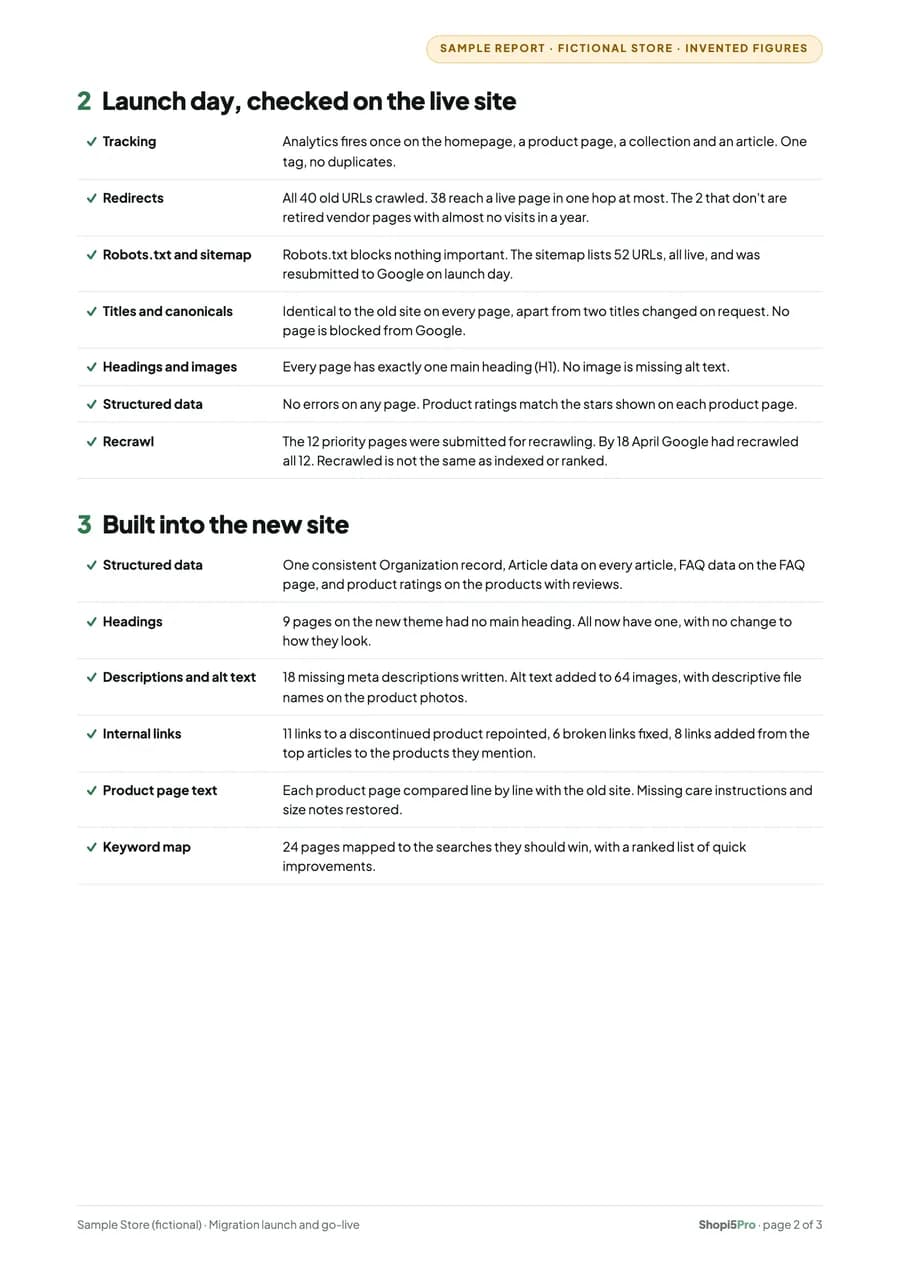
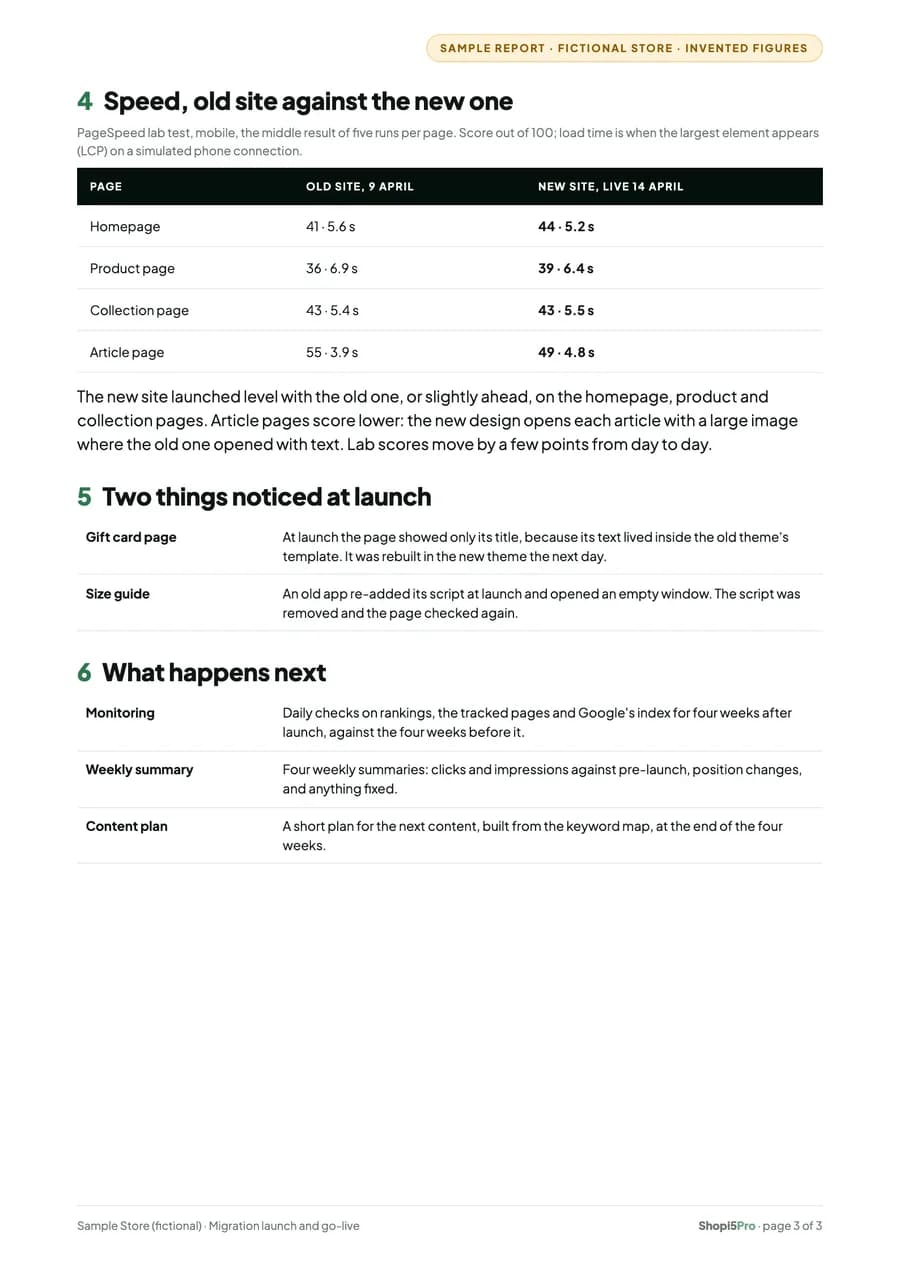
A migration ends with a launch report: where the site stood, every check run on the live site on launch day, what was built into the new theme and what happens next. This sample uses a fictional store, so every name and figure in it is invented.

Sample report · fictional store · invented figures

What's inside

  • Where the site stood before, and at launch
  • Launch-day checks on the live site
  • What was built into the new site
  • Speed of the old site against the new one
  • Anything noticed at launch, and the next four weeks
Open the Sample Report (PDF) (opens in a new tab)

3 pages · A4 · opens in a new tab

Why This Matters for a Store

A migration that keeps old URLs resolving, keeps the sitemap honest and carries metadata and structured data across protects the store's ability to be found while everything else is changing. Just as useful for the business is the record: a written account of what was checked, what was fixed and what was left, so the team knows where the site stands and what to watch in Search Console over the following weeks.

Project details are anonymised. Figures are drawn from documented delivery checks and do not imply guaranteed ranking outcomes.

All services
  • SEO & Performance

    Technical SEO

    Resolve indexing, structured data, redirect and crawlability issues that can hold your store back.

    Explore Technical SEO
  • Development

    Shopify Development

    Custom theme work, storefront improvements and functionality tailored to how you sell.

    Explore Development

Further Reading

Guides and case studies that explain this work in more depth.

Have a Similar Challenge?

Tell us what is changing: a new theme, new URLs, a platform move or a restructure. We'll explain what needs protecting before launch.

You don't need a technical specification. A description of what you're seeing is enough to start.

Helpful to include

  1. What is changing and roughly when
  2. Pages that matter most to your sales or search traffic
  3. Any redirects or apps already in place

Enquiry about: Technical SEO

Tell us what's happening, what you'd like to achieve and anything relevant about your setup. At least 30 characters.

Please don't include passwords, API keys or sensitive customer data in this form.

Prefer the full form? Use the contact page